A pottery shop may sell a single vase, a repeatable mug in several glazes and places on a weekend workshop. These offers need different promises. The vase can disappear after one sale, the mug may depend on a future firing, and the workshop has a capacity set by the studio. A coherent website should explain those differences without making every offer look immediately available.
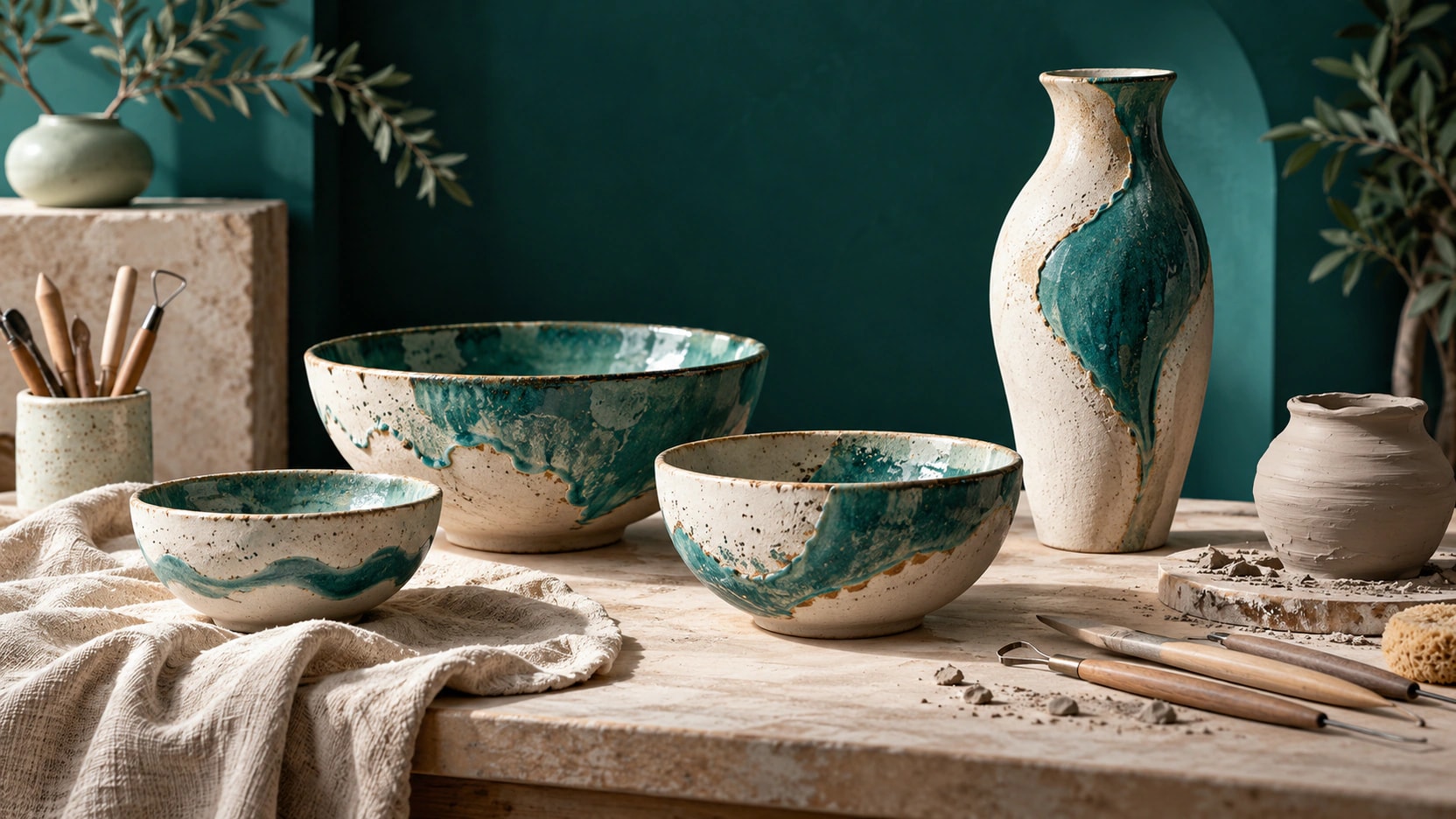
Stonemade, CraftXtore and Jeremy’s Pottery are three WordPress themes associated with ceramics and handmade products. Their builders, presentation tools and maintenance arrangements differ. This comparison uses official sources reviewed on 29 October 2026. It does not claim installation tests, measured speed or verified sales results. The illustration is conceptual artwork rather than a theme screenshot.
Model the studio’s products before selecting layouts
Begin with an inventory distinction: unique pieces, stocked small batches, made-to-order work and class enquiries. Show whether the customer receives the photographed object or a similar handmade piece. Record dimensions and glaze variations consistently, and explain how the studio communicates a production delay. A theme cannot establish food-contact suitability or guarantee the outcome of a kiln firing.
WooCommerce can hold product and variation stock, while the theme makes that information visible. Fragile shipping, collection arrangements and workshop reservations need separately defined rules. A workshop page is not a seat-allocation system simply because it includes a date or a button. Keep orders and classes connected only where the actual booking implementation supports it.
| Theme | Documented approach | Displayed item price and limitation |
|---|---|---|
| Stonemade | Elementor pottery storefront with product-showcase elements | US$79; visible release and compatibility details need reconciliation |
| CraftXtore | Elementor shop with catalogue filters and multiple starter layouts | US$48; maintain Bzotech companion components together |
| Jeremy’s Pottery | WPBakery ceramics presentation with class and event content | US$69; check legacy dependencies and actual booking entitlement |
Stonemade
Stonemade’s listing describes three initial homepages, Elementor and WooCommerce compatibility, product-showcase elements and an included child theme. Its update log names Qode Framework and Stonemade Core. The US$79 offer shows future updates and six months of support, with a 100% GPL label. Its visible May 2025 release is older than some displayed compatibility badges.
That makes it a design-led shortlist candidate with a release-verification question. Ask the author to confirm the current downloadable theme, core plugin and framework versions against your intended Elementor and WooCommerce stack. Compatibility entries for WPBakery in a sidebar do not override the main Elementor presentation. Neither a Gutenberg badge nor a child theme establishes native Full Site Editing.
For a studio review, use one sold-out piece and one product with several glazes. Evaluate whether a visitor understands the difference without reading a long policy page. Keep variation photography honest: a generic swatch should not imply identical markings across handmade objects. The ability to build an attractive showcase matters most when it helps explain the actual object, scale and making process. Ask who can maintain those details after the designer leaves.
CraftXtore
CraftXtore advertises eleven home layouts, Elementor, WooCommerce, AJAX shop filtering and a free-version FOX integration. The current listing identifies version 2.0.1 dated 7 October 2026 and updates to Bzotech Core and Bzotech Elementor. Its US$48 marketplace offer includes future updates and six months of support. Older indexed summaries still show an earlier release, so use the current package details.
Its useful direction is a studio with enough product categories to justify a more developed shop. The limitation is the companion stack: obtain the complete required-plugin list for the chosen demo and maintain the components as a supported group. “Ready” for a currency or slider tool does not prove that every commercial tier, direct update entitlement or premium template library is included.
Before adopting filters, define categories customers can actually understand: functional ware, decorative objects, collections and availability. Avoid a long list of glaze names that only the maker understands. Ask for a demonstration using a unique vase with stock of one, including a second shopper reaching the product after it sells. Decide how an archive of sold work should guide commissions without implying that the photographed item can still be bought.
Jeremy’s Pottery
Jeremy’s Pottery describes WPBakery layouts, WooCommerce, classes, events and gallery content. Its listing also references Essential Grid and Revolution Slider. The displayed price is US$69, including future updates and an initial six-month author-support period. The marketplace shows a September 2025 update; references to older frameworks and integrations should be checked against the download you would actually receive.
The theme’s value for a shortlist is the combination of maker storytelling and class-oriented presentation. The boundary is operational: class or event modules do not establish paid bookings, waitlists, instructor allocation or a guaranteed number of seats. Ask which plugin stores the events and whether the desired registration workflow requires an additional licence or service.
This choice deserves particular attention if the studio already owns WPBakery content. Request a migration sample that preserves workshop descriptions, image captions and internal links without carrying over unwanted demo shortcodes. If this is a new site and nobody wants to maintain that ecosystem, include the future editing effort in your decision. Familiarity for one contractor is not necessarily a sustainable workflow for a studio owner who changes class dates every month.
Licences, support and realistic recurring costs
The three quoted figures are US-dollar listing prices before tax and handling fees. They are not quotations for a functioning pottery business. Standard marketplace offers describe one end product; GPL rights, supported activations and purchase-linked services are distinct questions. Confirm arrangements for additional independent stores or client sites with the author. No same-author free edition was verified for these products.
Future updates are advertised, but ongoing personal support has its own extension or renewal terms. An exact annual theme-renewal charge was not verified, so do not present the initial payment as an all-inclusive lifetime service. Allow separately for hosting, email, payments, shipping tools and any booking system. A bundled slider may have a different update route and support entitlement from a direct licence bought from its developer.
Write a brief around one real batch and workshop
Give your developer a small launch batch with measured dimensions, actual photographs and clear stock counts. Add a made-to-order item with an estimated dispatch window that requires studio confirmation. Decide whether deposits, cancellations or custom inscriptions are permitted before designing purchase controls. Avoid using a variation selector for an option the workshop cannot reliably produce.
For shipping, determine packaging classes and destinations with the fulfilment provider. WooCommerce shipping zones can narrow available methods by customer address, but they do not demonstrate packaging suitability or carrier handling. Ask to see an excluded destination and a local collection order in staging. Keep damage reporting instructions understandable and use your own approved policies rather than sample legal copy.
Review mobile gallery navigation, keyboard access to product options and the clarity of stock messages. Check that captions explain surface variation rather than describing every object as identical. These are proposed acceptance checks, not results of hands-on testing here. Our WooCommerce foundations comparison offers a broader starting point. The print shop comparison explores another business where custom production must be distinguished from ordinary stock.
Choose the presentation your studio can sustain
Shortlist Stonemade for an Elementor-based product showcase after resolving release questions. Consider CraftXtore when a larger catalogue benefits from structured shop navigation and you can maintain its companion stack. Explore Jeremy’s Pottery for WPBakery continuity and class-oriented content, with booking requirements separately verified. The final choice should preserve accurate stock and production expectations while giving your own ceramic work room to speak.